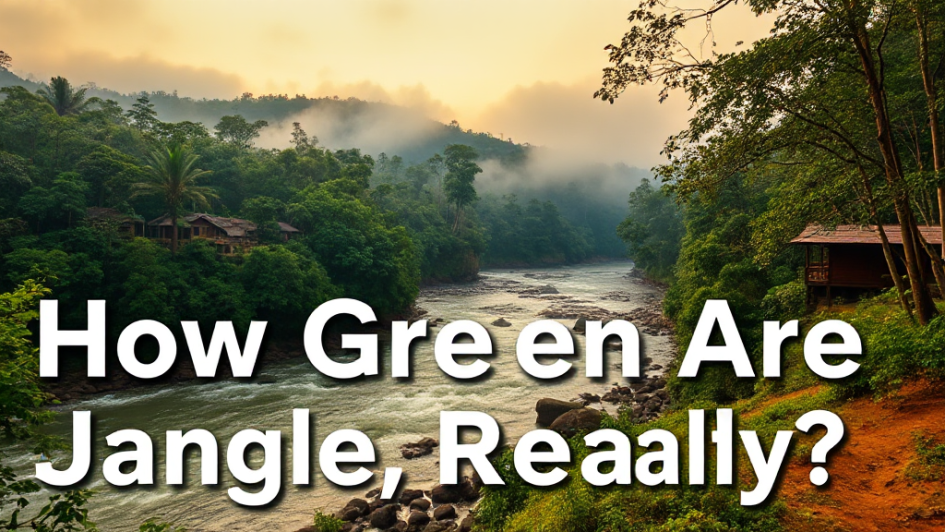
How Green Are Dandeli Jungle Resorts, Really?
What does a jungle resort leave behind after the guests go home? It is a simple question, but the answer is rarely simple. Dandeli sits in the Western Ghats of Karnataka, wrapped in deciduous forest, cut by the Kali River, and home to hornbills, Malabar giant squirrels, and the occasional leopard moving quietly through the undergrowth. The region has become a popular weekend escape for rafting, coracle rides, and forest stays. But as more dandeli jungle resorts open their gates, the question of what they leave behind — in waste, in water use, in wildlife disturbance — deserves a closer look.
This is not an attack on the hospitality industry. It is a traveler’s audit, written from the perspective of someone who loves these forests and wants to keep loving them. Below are the hard questions worth asking before you book, and the answers that separate genuine eco-tourism from green marketing.
Where does the waste actually go?
Every resort generates waste: food scraps, plastic packaging, glass bottles, and the quiet, constant stream of guest amenities. In a remote forest setting, waste management is not a municipal service you can take for granted. The question is whether a property has a real system or simply a back gate.
Responsible jungle stays in Dandeli tend to follow a few visible practices. They separate wet and dry waste at the source. They compost food waste on-site rather than trucking it to a landfill or, worse, burying it near the property boundary. They limit single-use plastics — steel bottles in rooms instead of shrink-wrapped water, cloth bags instead of polythene at the front desk. And they can tell you, without hesitation, where their garbage goes.
Ask directly: “What happens to your food waste?” If the answer is vague, that is information in itself. A resort that has thought about its footprint will usually be proud to explain the compost pit, the biogas unit, or the tie-up with a local recycling partner. One that has not will change the subject.
Is the resort taking more water than the forest can spare?
Dandeli is not a water-scarce region in the way that, say, Rajasthan is. The Kali River flows through it, and the monsoon is generous. But that abundance can breed complacency. A resort with fifty cottages, a swimming pool, landscaped lawns, and long hot showers can draw heavily on local groundwater, especially in the dry months between January and May.
The greenest properties treat water as a resource with limits. They harvest rainwater from rooftops and use it for landscaping or flushing. They install low-flow fixtures. They avoid thirsty ornamental lawns in favour of native plants that survive on rainfall alone. Some go further, treating greywater from bathrooms and kitchens in constructed wetlands before it re-enters the soil.
You do not need to inspect the plumbing to get a sense of this. Look at the landscaping. If the grounds are full of manicured grass and exotic flowers that need constant irrigation, the resort is probably not water-wise. If the planting is native, dense, and a little wild, that is a good sign. Ask whether the pool is cleaned with chlorine or a salt system, and whether the resort reuses towels and linens by default rather than on request. Small operational choices add up.
How close is too close to the wildlife?
This is the hardest question of all, because the line between “immersive nature experience” and “wildlife disturbance” is thin and often invisible to guests. Dandeli’s forests are not a zoo. The animals that live there — gaur, elephants, deer, langurs, and a rich bird population — need space, quiet, and darkness.
A resort that genuinely respects wildlife will keep its lights low and shielded at night, so that nocturnal animals are not disoriented. It will keep loud music and late-night bonfires away from the forest edge. It will not offer “guaranteed sightings” or encourage guests to crowd around a herd for photographs. It will brief guests on quiet hours and safe distances, and it will enforce them.
Ask about the resort’s buffer. How far are the cottages from the nearest dense vegetation? Are there fences, and if so, are they wildlife-permeable? Does the property run night safaris in vehicles that shine high-beam lights into the undergrowth, or does it offer guided walks with trained naturalists who understand animal behaviour? The difference matters. A naturalist who knows when to stop and when to stay quiet is worth more than a jeep with a spotlight.
It is also worth asking how the resort handles human-wildlife conflict. Dandeli has elephants and leopards. A responsible property has protocols: staff training, safe waste storage that does not attract animals, and clear communication with the forest department. If a resort brushes off these concerns, take that as a warning.
What does “local” actually mean here?
Eco-tourism is not only about trees and water. It is also about people. A jungle resort that imports its entire workforce from outside the region, buys vegetables from a distant city, and sends profits to an urban head office is not contributing much to the local economy. The greenest stays in Dandeli hire from nearby villages, source food from local farmers where possible, and train young people as guides and naturalists.
This is where the dandeli jungle resorts listed by established booking platforms can be assessed more critically. A property like Golden Eagle Jungle Stay or White Tusker Jungle Stay may offer packages with free rafting, but the real test is whether those packages also include local guides, whether the food is regional, and whether the staff can tell you the name of the river bend you just rafted past. Authenticity is not a marketing slogan; it is the difference between a stay that feels like a theme park and one that feels like a place.
Ask who owns the resort, where the staff come from, and whether the property supports any local conservation or community initiative. You may not always get a detailed answer, but the way the question is received tells you something. A resort that has never thought about its local footprint is unlikely to have thought deeply about its environmental one either.
None of this is about finding a perfect resort. Perfect is not on the menu in a region where tourism and conservation are still learning to coexist. It is about asking better questions, rewarding the properties that take them seriously, and accepting that a jungle stay always carries an impact. The goal is to make that impact small, honest, and visible. So before you book that cottage under the trees, ask what happens after you leave. The forest will thank you for it.
Leave a Reply